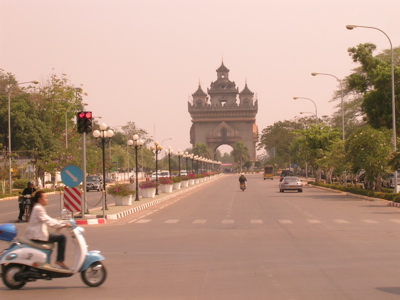
(Patu Xay monument or the “concrete monster” according to a plaque on its wall. Never completely finished, according to the Lonely Planet, the concrete used for building this monstrosity was originally intended by the US government for building schools… is this what we call ‘development aid’?)
Did you know that the People’s Democratic Republic of Laos is one of the poorest and most isolated places in the weird, and more sadly the most heavily bombed country in the world? Even with all these negativities that characterize this small land-locked country in between Thailand in the west, China in the north, Vietnam in the east, and Cambodia in the south, Laos PDR is a remarkably resilient place. Although I would have people tell me differently (i.e. how the Lao government in cooperation with the Thai government is punishing its ethnic minority population, particularly the Hmong people), I had a chance to visit Vientiane the capital city where people are friendly and the atmosphere felt the opposite of Bangkok – relaxing.
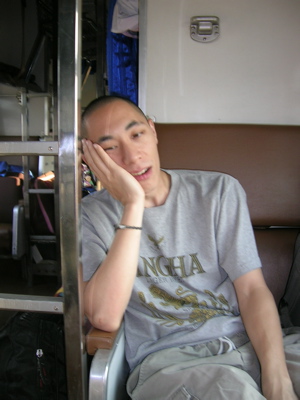
(This was after 22 hours on a train that was suppose to be 12 hours. We caught an overnight train on Monday night and after almost 24 hours arrived in Nong Khai, the gateway city to Vientiane, on Tuesday night. From what the conductor was trying to explain, there was an accident on Monday night and we couldn’t make up to Nong Khai during the night… my question is, for the 12 hours we were traveling on Monday night where were we going? In circles?)
Wide boulevards, people friendly streets, and a street grid pattern were the norm. So too were the numerous little open-air shops, stalls, and outdoor cafe’s the fill the streets… one of the benefits of French colonialism. Interrupting the flow of these European comforts were wats, temples and markets that are distinctly Laotian. Its quite easy to see why so many foreigners come to Vientiane for a few days and end up staying in Laos for weeks or even end up setting up a busy (usually a coffee shop) and living here.
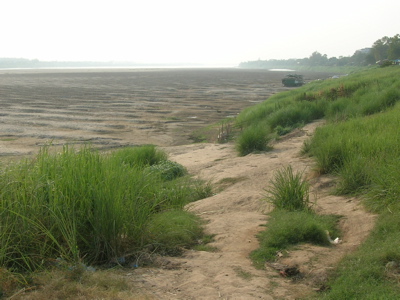
(The mighty Mekong River from the Laos side. I’m not sure if the river naturally dries up this much, or could all this climate change talk be true? If you want, you can practically walk from the right of this picture (i.e. Laos) to the left of the picture (i.e. Thailand)… I can see why Thailand doesn’t really like having people enter its borders, but with so many poor countries surrounding it, there’s not much Thailand can do about unchecked borders like this one)
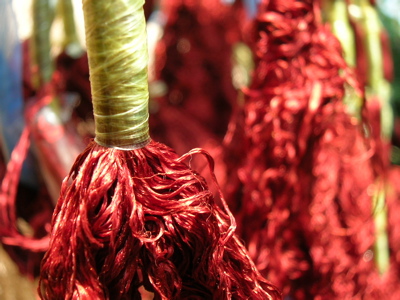
(Silk drying at Carol Cassidy’s workshop and store in Vientiane. An excellent place to see, feel, and of course buy, silk textiles. There is even a workshop at the back of this turn of the century house where there are about 20-30 women weaving the silk products together. 2 questions came to mind when I was wandering through the workshop: 1) how do you define sweatshops and textile “factories”? and 2) does it see strange to have a foreigner revive a local industry (ex. Thailand’s Jim Thompson)?
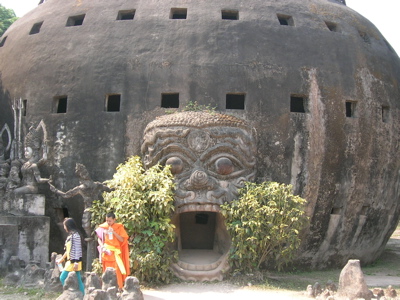
(Buddha Park… a strange yet scenic spot which a monk built to visually show his interpretation if Buddhism and Hinduism came together. Its about 5km east of the Thai-Lao Friendship Bridge on a dirt path which reminded me a lot of Cambodia… very different from the capital city)
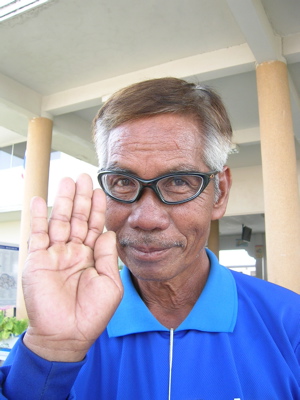
(This was a tuk tuk driver who kept convincing me to get away from the Nong Khai train station to visit the town before my train was to leave 4 hours later. I eventually took up his offer but not before he wanted to try my glasses on. It was a little scary to know that he smelled like beer, but then again the tuk tuk ride was only 10minutes)
your tuk tuk driver was drunk? Isn't that normal???? LOL. 😉
His pic is hysterical by the way. I think you should make it your new profile pic. 😉